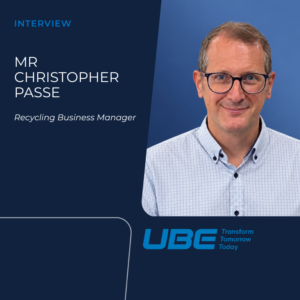




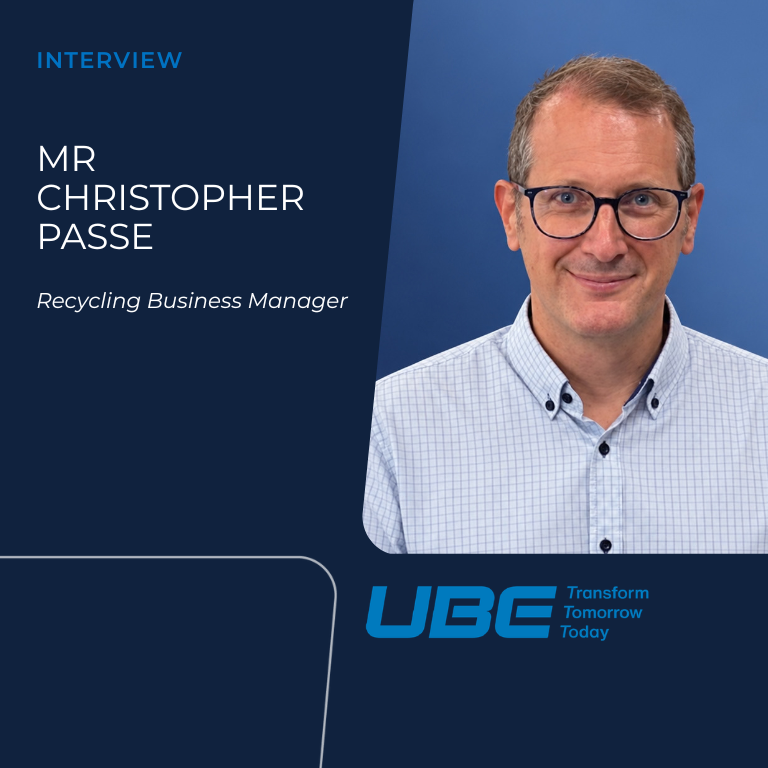
Interview with Christopher Passe, Recycling Business Manager
Introduction:
The demand for recycled-content plastics is growing across many industries. The market is not only looking for recycled materials; it increasingly requires quality consistency, traceability, technical support and material solutions that can be evaluated for real-world applications.
Following the integration of Paulowsky into the UBE Group, UBE combines recycling expertise, compounding capabilities and long-standing polymer know-how. This combination helps translate recycled feedstock into application-oriented material solutions, particularly in mobility, non-food packaging and industrial applications.
Q1. Christopher, why are recycled-content materials becoming more relevant for customers?
Several industries are rethinking their approach to materials sourcing and selection as regulatory requirements and market expectations continue to evolve. Developments such as PPWR in packaging and future ELV requirements in the automotive value chain are contributing to a growing focus on recycled content, traceability and material documentation.
However, the customer question is not only whether a material contains recycled content. Customers also need to know whether the material can meet their technical requirements, whether its documentation is clear, and whether it can be processed consistently in their own operations.
This is why the discussion is moving from recycled content alone to quality, traceability and application performance.
Q2. What does UBE bring to this discussion?
UBE brings together three complementary capabilities: recycling, compounding and polymer expertise.
Paulowsky contributes recycling know-how and recycled-material production. UBE Composites Europe contributes formulation and compounding capabilities. UBE adds decades of experience as a raw material producer and polymer technology company.
Together, these capabilities allow us to support customers beyond the supply of recycled materials. We can help them evaluate material options, adapt formulations and work toward solutions aligned with specific application requirements.
Q3. Why was Paulowsky an important step for UBE?
Paulowsky gives UBE a stronger position in recycled polyolefins, particularly recycled polypropylene and polyethylene. The company brings recycling experience, process know-how and certified recycling operations.
This is important because customers need confidence in the starting point of the value chain. Controlled recycling processes, filtration technology, quality checks and traceability systems are essential when recycled materials are intended for demanding applications.
By integrating Paulowsky, UBE can connect recycled feedstock with downstream material development and compounding capabilities within the group.
Q4. How does UBE Composites Europe create additional value for customers?
UBE Composites Europe helps transform recycled or recycled-content feedstock into more application-oriented compounds.
Depending on the final application, customers may need specific mechanical properties, impact performance, dimensional stability, appearance, colour, reinforcement, flame-retardant properties, UV or heat stabilization, or other functional characteristics.
Through formulation development and compounding know-how, UBE Composites Europe can work with customers to adapt materials to defined requirements. This is especially relevant when customers want to introduce recycled content while maintaining the technical expectations of their application.
Q5. Why is UBE’s background as a raw material producer important?
Recycled-content materials still need to behave as materials in real production environments. UBE’s experience in polymer design, material characterization, processing and application development helps us understand how materials perform and how they can be improved.
This background is valuable when customers need to assess processing behaviour, mechanical performance, long-term requirements or compatibility with existing production processes.
In practical terms, UBE is not approaching recycling as an isolated activity. We are connecting recycling with material science, compounding and application development.
Q6. What role do traceability and certifications play?
Traceability and certification are important because customers need documented information to support material selection, qualification processes and compliance-related discussions.
Paulowsky operates recycling processes certified by RecyClass. UBE Composites Europe has also obtained AENOR certification for recycled-content traceability, and ISCC PLUS certification supports traceability approaches. Independent certifications support transparency, traceability and confidence throughout the value chain.
Q7. What should customers take away from UBE’s approach?
The main message is that recycled content is only one part of the decision. Customers also need material consistency, technical support, traceability and the ability to adapt materials to real applications.
UBE’s approach connects Paulowsky’s recycling know-how, UBE Composites Europe’s custom compounding capabilities and UBE’s long-standing polymer expertise.
For customers evaluating recycled-content solutions, this means access to a partner that can support the journey from recycled feedstock to engineered material solutions for mobility, non-food packaging, industrial applications and consumer products.
If you are interested in evaluating recycled-content materials for specific applications can contact UBE to discuss material requirements, available documentation, formulation options and development priorities.
For more information, please contact here.
—
1 The Packaging and Packaging Waste Regulation (PPWR) aims to set packaging reduction targets gradually increasing from 2030 to 2040, requiring EU countries to significantly reduce plastic packaging waste and setting mandatory recycled content targets in packaging products by 2030.
2 The European Directive 2000/53/EC on end-of-life vehicles (ELV) has been revised by the new proposal for a Regulation for ELV, and it mandates measures to prevent and limit waste from end-of-life vehicles and their components through reuse, recycling, and recovery, adding the new proposal mandatory recycled content targets on the automotive sector.
3 Applicable for specific grades.
4 Applicable in specific products.
5 Applicable for certain materials and value chains.