



Thermoforming applications in food packaging require film structures capable of balancing flexibility, puncture resistance, optical properties, and forming behavior. The selection of polyamide structures therefore plays an important role in defining the final mechanical and thermoforming characteristics of the film. In these applications, nylon composition directly influences the balance between flexibility, puncture resistance, and thermoforming performance.
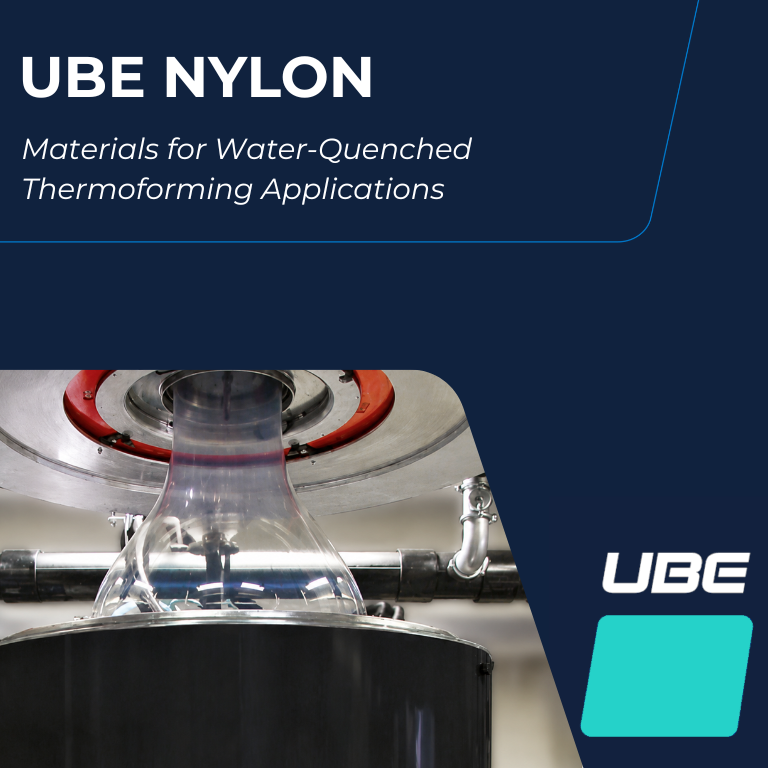
UBE NYLON provides several grades for water-quenched multilayer film structures, including UBE NYLON 1030B, 5032B, 5034B, and 6434B. The comparative data presented for 150 µm total film thickness structures with 30% PA thickness shows distinct mechanical and thermoforming characteristics depending on the nylon structure used. The evaluated grades also present varying optical and puncture resistance properties.
Among the compared grades, tensile modulus values range from 280 MPa for UBE NYLON 1030B to 222 MPa for UBE NYLON 6434B, while tensile elongation at break increases from 476% to 571%. These variations illustrate how nylon composition influences film flexibility during thermoforming applications.
The materials also present different puncture resistance values. UBE NYLON 1030B shows puncture energy values of 42 mJ, while UBE NYLON 6434B reaches 56 mJ. The evaluated grades also maintain stable optical properties, with haze values between 4% and 5%.
Thermoforming behavior also varies according to the nylon grade evaluated. UBE NYLON 1030B and 5032B present maximum thermoforming depths of 65 mm, while UBE NYLON 5034B and 6434B reach 75 mm and 80 mm respectively under the evaluated conditions. These differences illustrate how thermoforming performance changes according to the nylon structure evaluated.
UBE NYLON grades therefore provide specific balances between flexibility, puncture resistance, optical properties, and thermoforming behavior for food packaging film applications.